
Background
Extreme heat is becoming an increasingly urgent challenge across Asia and the Pacific, affecting people’s health, livelihoods, productivity, and well-being, as well as the resilience and liveability of cities and communities. With the prospect of Super El Niño conditions further intensifying heat risks, there is an urgent need to strengthen preparedness and action before extreme heat becomes even more severe.
The impacts of extreme heat are not experienced equally. People who spend long hours outdoors, including informal and outdoor workers, as well as older persons, children, persons with disabilities, pregnant women, people with underlying health conditions, and communities with limited access to adequate housing, cooling, green spaces, and social protection, can face significantly greater exposure and vulnerability. Women, particularly those working in the informal sector and those with significant unpaid care responsibilities, often face additional risks, including from patterns of work, mobility, access to resources, and care burdens. In cities, heat risks can also vary considerably between neighbourhoods, with densely built-up areas, limited green spaces and ventilation, and patterns of land use contributing to localised heat hotspots. These conditions can increase risks to health, productivity, mobility, liveability, and urban resilience, particularly for vulnerable populations.
Extreme heat therefore cannot be treated as a health issue alone. Its impacts extend across livelihoods and labour, social protection, urban planning, disaster risk reduction, climate adaptation, infrastructure, and public services, and can deepen existing gender and socioeconomic inequalities. Heat needs to be treated with greater urgency, with multiple sectors having a role to play. Social protection is a critical tool to both safeguard people’s income and livelihoods when disrupted by heat, and to build households’ resilience to these risks. National and local governments can strengthen policies, preparedness, and public services; humanitarian and civil society organisations can work directly with communities and vulnerable groups; communities themselves bring critical knowledge and experience; and the private sector and technology partners can contribute new data, tools, and solutions to support more targeted action. However, responsibilities and responses are often fragmented across institutions, sectors, and levels of government, limiting the ability to identify, reach, and protect those most at risk. Stronger coordination and partnerships across actors will therefore be essential for delivering effective and inclusive heat action.
Across the region, different actors are already taking action, from heat-health preparedness and early warning to protection for workers and vulnerable groups, community-based action, urban planning and nature-based solutions, and the use of data and technology to better understand where heat risks are concentrated. Ensuring that these responses account for gender, age, disability, occupation, and other intersecting factors will be critical to reaching those most at risk.
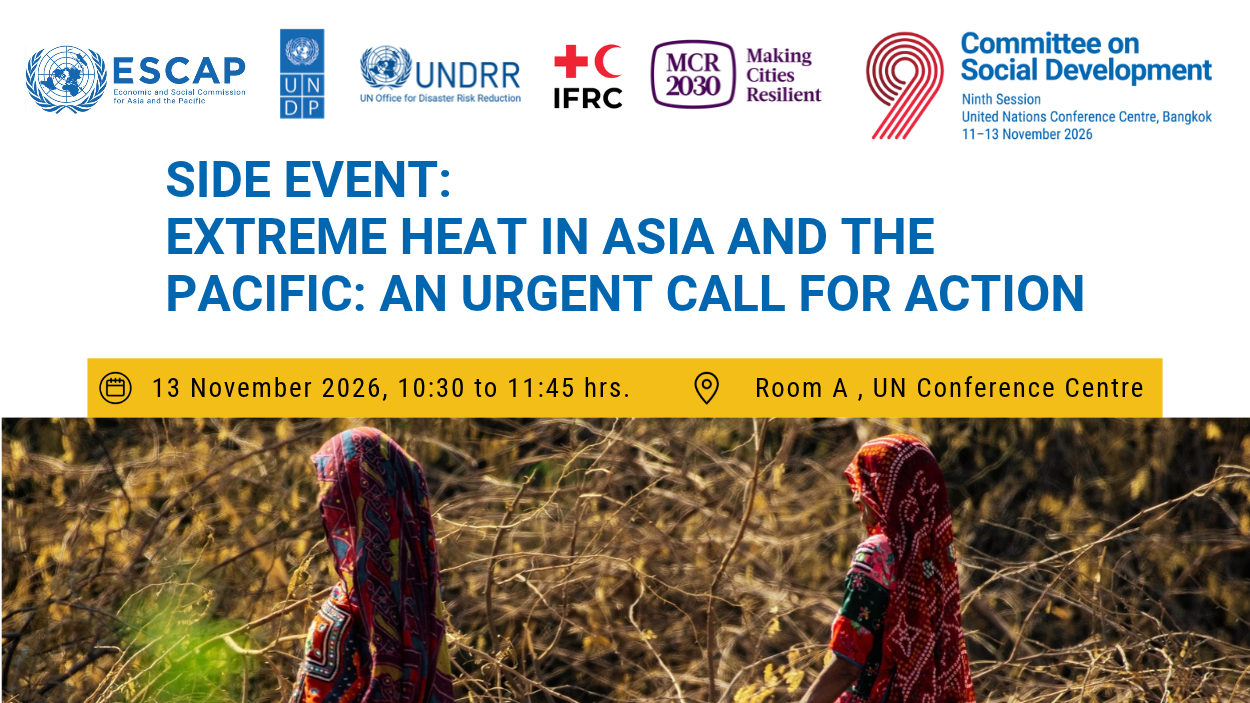
Against this backdrop, UNDP, ESCAP, UNDRR, and IFRC will jointly convene this side event during the Ninth Session of the Committee on Social Development to highlight the urgency of addressing extreme heat and its disproportionate impacts on vulnerable groups. Beginning with the lived experience of an informal worker, the event will bring together perspectives from governments, cities, humanitarian and civil society organisations, technical experts, and the private sector to demonstrate that everyone has a role to play in protecting people from extreme heat and to identify practical opportunities for collaboration to accelerate action across Asia and the Pacific. Beyond the event, the co-organisers will leverage their respective networks and platforms to carry the discussion forward across global, regional, national, and city levels, helping to build greater urgency, strengthen cooperation, and call for accelerated action on extreme heat. This includes ESCAP’s regional convening role, UNDP’s extensive network of Country Offices, UNDRR’s Making Cities Resilient 2030 (MCR2030) initiative, and IFRC’s wide network at the national and community levels.
Objectives and key questions
Objectives
Increase awareness of the urgency and unequal impacts of extreme heat, particularly on vulnerable group, including its gender-differentiated impacts, by bringing their lived experiences and needs to the centre of the discussion.
Highlight practical actions and approaches, including on social protection, from different actors, including national and local governments, humanitarian and civil society organisations, communities, and the private sector, demonstrating the different roles each can play in addressing extreme heat.
Identify ways forward to accelerate action on extreme heat across Asia and the Pacific, particularly in anticipation of potentially intensifying heat risks, and strengthen protection for those most exposed and vulnerable.
Key questions:
How is extreme heat affecting people across Asia and the Pacific, particularly vulnerable groups, including women, informal or outdoor workers, and those facing intersecting forms of vulnerability, and what do their lived experiences tell us about where action is most urgently needed?
What actions, including on social protection, are governments, cities, humanitarian and civil society organisations, communities, and the private sector taking to protect people from extreme heat, and what can be learned from these experiences?
With heat risks expected to intensify, how can different actors work together more effectively to protect vulnerable groups from extreme heat, and what opportunities exist to strengthen collaboration and scale up action across Asia and the Pacific?